Welcome
Contents* Latest news
* On a global mindshift towards 21st century thinking
* The need for better tools
* Some further analysis on socioeconomic trends and their implications
* About me and this rambly site
* Lots of links to my writings
* Licensing notices
"The biggest challenge of the 21st century is the irony of technologies of abundance in the hands of those still thinking in terms of scarcity."
--Paul Fernhout
Latest news
☮ May 2022: Added a "Note on the Origins of Post-Scarcity Princeton".
☮ March 2022: Here is a Slashdot post I made on how the next World War could be avoided by using a Newer Way of Thinking, supported by Free/Libre Open Source Software tools for doing Dialogue Mapping using IBIS and various other mediation and collaboration techniques, used to work towards mutual intrinsic security based on all the technologies of abundance we have invented (e.g. solar panels, electric cars, superinsulated homes, permaculture, agricultural robots, CAD/CAM and 3D printing, computer-facilitated learning, and so on) but not yet widely deployed enough for the benefit of all.
And also, I prepared another five minute "lightning talk" for LibrePlanet 2022 on "Free/Libre Standards for Social Media and other Communications". The text of the talk in IBIS outline format is available here. The text was updated after making the video by adding another con item at the end about some standards organizations putting restrictive copyrights and patents on their standards and also adding a license and source link.
☮ February 2022: Here is a Slashdot post on inspiring authors with alternative visions and insights related to transcending conflicts by increasing global peace and prosperity and mental wellness. In general, I find inspiration in the works of authors from fiction by Theodore Sturgeon ("The Skills of Xanadu"), James P. Hogan ("Voyage from Yesteryear"), Timothy Gawne ("Old Guy Cybertank series"), Ursula K. Le Guin ("Always Coming Home"), to fiction plus non-fiction by Miki Tashan ("Reweaving Our Human Fabric") and Marshal Brain ("Manna" and "Robotic Nation"), to non-fiction by Buckminster Fuller ("Utopia or Oblivion"), Martin Gardner ("Self-Renewal: The Individual And Innovative Society"), Milton Mayeroff ("On Caring"), James Carse ("Finite and Infinite Games"), John and Julie Gottman ("The Art and Science of Love"), Morton Deutsch ("Beyond Intractibility"), Jeff Conklin ("Dialogue Mapping: Building Shared Understanding of Wicked Problems"), Jimmy Carter, Eleanor Roosevelt, Martin Luther King, Mahatma Gandhi, Pope Francis, and many others. That does not mean I agree with all they write, just that they all are inspiring essentially in a common way about moving towards abundance in our lives through improved communications and better collaboration towards shared goals. When times get difficult, it is often helpful to look towards our guiding stars to orient ourselves, and those are some of mine.
Here is also a couple of Slashdot posts by me in honor of the late Douglas Trumble on how his move "Silent Running" affected me when I was about ten years old. In a way, the authors mentioned above have answers to the social questions posed by Silent Running about caring and social change to support a healthy integration of nature, technology, and society.
☮ September 2021: The High Performance Organizations Reading List I put together and continue to update was discussed on Hacker News and has around 1000 stars.
☮ May 2021: Reading about humor writing and thinking of changing my sig to "The only thing we have to fear is scarcity-fearing fools misusing plenty-providing tools".
☮ March 2021: I prepared a five minute "lightning talk" for LibrePlanet 2021 on "Empowering users through Dialogue Mapping using IBIS". The text of the talk in IBIS outline format is available here. The text was updated after making the video by adding example of pros and cons and also adding a license. That talk is a much-shortened version of a longer talk I gave in July 2019 for the Cognitive Systems Institute Group Speaker Series.
☮ May 2019: An essay I wrote on why I prefer Mithril over React for JavaScript UI development
☮ October 2018: I re-dedicated the book Post-Scarcity Princeton in memory of a close friend from college who I recently found out passed away several years ago.
☮ April 2018: I ported StoryHarp from Delphi to the web using TypeScript, Mithril, and Tachyons. You can now run StoryHarp in your browser.
☮ March 2017: I put together a High Performance Organizations Reading List.
☮ January 2016: An essay on reasons not to use Slack for free software development.
An email to Richard Stallman suggesting a campaign about a a pledge for foundations and non-profits to only fund and create free works.
And here is a link to a no-doubt overly-long and overly-enthusiastic job application document as essentially a programming and FOSS autobiography intermixed with ideas about how what I had learned over the years could help Automattic (the main developers of WordPress) -- or, to some lesser extent, any other large FOSS effort, including Drupal/Acquia. After waiting a couple of months in the Automattic interview queue, that application fizzled over whether I was willing to use Slack for the job interview at Automattic. My reason for concern over Slack use at Automattic was that, as good as Slack is, the proprietary venture-funded Slack is disrupting the open-source communications ecosystem which WordPress is a big part of. I enjoyed writing that application document overall, and I still hope some of the ideas in it can still help Automattic grow even more in a FOSS direction (or other similar companies like Acquia with Drupal). That document is at least something for my kid to perhaps read someday many years from now. Of course, my kid may just read it and then say, not without significant justification, that I probably should have put the principle of family ahead of other principles in turning down any significant chance for a six-figure salary work-from-home job on FOSS. :-( We always have many principles to choose from, and it can indeed be hard sometimes to get the priorities right. As Scott Berkun (who left Automattic after a year to go back to writing full-time) wrote, even in a metrics-driver organization like Automattic, there is no metric for picking metrics or deciding how to weigh a variety of metrics (beyond perhaps survival itself).
Here is a version of Twirlip I started as a proof-of-concept Thunderbird Server webapp to handle email, chat, and other real-time communications as another step towards a social semantic desktop. It is the beginning of the embodiment of the "ThunderbirdS Are Grow! Manifesto". But if you are looking for something good now that is FOSS, check out Mattermost, Matrix.org, Mailpile, Kolab, and similar things.
☮ December 2015: My wife's Narratopia conversational story sharing card game is now on sale! It's kind of funny to see what once was state-of-the-art defense technology adapted to helping families and friends grow closer -- but after all, what better defense is there against life's uncertainties? :-) You can read more about Narratopia on my wife's blog at this later blog post on going to production or this earlier blog post on the design process by her. If you look carefully at the demo video, you can see our dog for about a frame or two, as our dog decided to jump onto my lap and stay there for about half of the game after we started recording -- which is why I usually had to ask someone else to pass me the cards. :-) Narratopia might make a good holiday present for any family. :-) If you like her work or my work, please buy a copy of Narratopia for your family and/or friends if you can afford it. The game is still a bit pricey as it is still on-demand production though; sorry. Otherwise, as ever, please "pay it forward" someday by helping others, including perhaps by advocating for a basic income for all. :-)
Here are some technical details about why and how we moved our free and open source NarraFirma "Participatory Narrative Inquiry" software (also based on once state-of-the-art defense technology researched in part for DARPA's Genoa II and Singapore's RAHS projects) from JavaScript, Dojo, and GFX to TypeScript, Mithril, and D3.
Anyway, it's been a good year of beating swords into plowshares -- even though now we're broke again and so I've been pawing through want ads for fifty year old programmers. :-)
Here is an essay called ThunderbirdS Are Grow! Manifesto -- Thunderbird Server as a Way Forward for Mozilla.
☮ November 2015: An essay by me on Why Encryption Use Is Problematical When Advocating For Social Change.
I finally got around to putting this (unsuccessful) DARPA proposal from 2011 up on: Participatory Sensemaking about Real-Life Cyber-Security Stories with Rakontu 2.0. Peter Neumann of RISKS Digest actually liked the idea and suggested I post it to RISKS Digest, but that was just before I started contracting at NBCUniversal, so the idea got stalled on my side with my becoming busy with a new job.
I've also become a Mandolin Orange fan. :-)
☮ October 2015: My wife and I spent a year (and then some) writing a single-page web app called "NarraFirma" to go with her Working with Stories book. We hope the NarraFirma software will increase demand for my wife's consulting and training services, as well as be of general benefit to many communities and organizations doing "Participatory Narrative Inquiry" (PNI) as a form of action research. The NarraFirma™ software uses JavaScript/TypeScript, Mithril, and D3. It can be hosted either as a WordPress plugin or a Node.js app. The software uses a version of the Pointrel triplestore system I have long been working on. Source code is available on GitHub. You can try it here.
Some previous Knight News Challenge entries by me on:
* Twirlip software for public intelligence and civic sensemaking
* NarraFirma software for Participatory Narrative Inquiry (PNI)
* Health Sensemaking software
* Rakontu software for story sharing and community sensemaking
☮ 2013: An essay by me on how abundances can create scarcities and other challenges.
☮ 2012: I made a copy on this website of a knol I created on "Beyond a Jobless Recovery: A Heterodox Perspective on 21st Century Economics" because Knol is shutting down soon.
Here is an insightful essay about a national dividend (basic income) from April 2007 by Richard C. Cook (a retired federal government analyst who worked for the U.S. Civil Service Commission, the Food and Drug Administration, the Carter White House, the U.S. Office of Consumer Affairs, NASA, and spent 21 years with the U.S. Treasury Department) on: An Emergency Program of Monetary Reform for the United States. A related six-part video series by him: Credit As A Public Utility.
☮ 2011: An essay by me related to peace issues and non-violent socioeconomic change: On Non-Violence and the OWS Movement
Some stuff about a workshop for Capitol Camp 2011
on Back to the (federated social semantic mobile future) desktop for eGovernment?
The workshop is archived here with video: Desktop or Mobile or Web.
Another workshop I ran there: Tools for Collective Sensemaking and Civic Engagement.
Here is an open letter to my Princeton classmate, Michelle Obama, about health, defense, and economic policy:
An open letter to Michelle Obama
On a global mindshift towards 21st century thinking
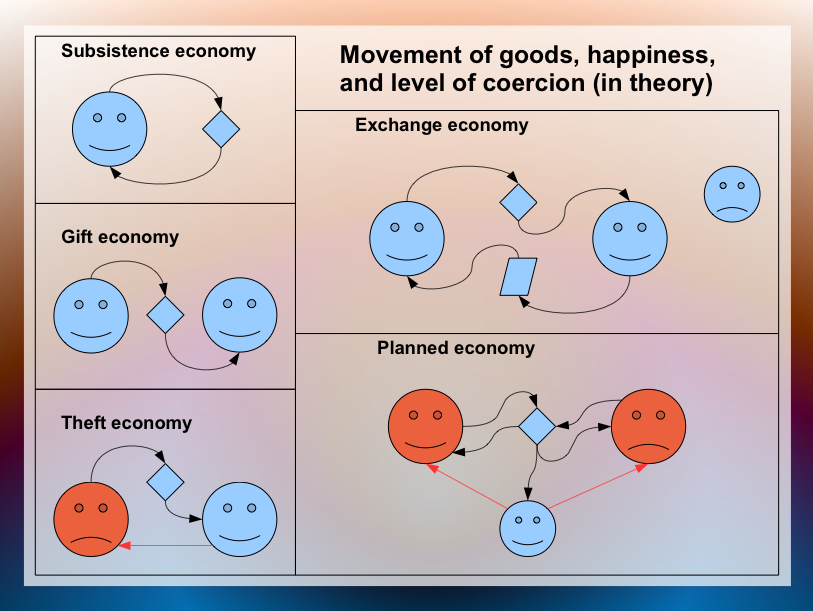
Diagram showing five types of economic transactions: subsistence, gift, planned, exchange, and theft, where red indicates coercion, and smiley faces indicate if someone is happy with the situation or not.
A summary of my thinking on socioeconomics and abundance is currently here and extended here.
In brief, there have always been five interwoven "economies" based on five different types of economic transactions (illustrated in the picture above). The balance of them changes with technological changes and cultural changes. They are:
* A subsistence economy. This involves production directly for ones own group, like gardening or hunting and gathering. For example, "There’s some lovely berries over here."
* A gift economy. This involves voluntary contributions to individuals or a community, like volunteering at a hospital. For example, "The meat from this deer I hunted is going to spoil; I'll share it with the tribe, and others will share their hunting results some other time as they have in the past."
* A planned economy. This involves a group deciding to do something together, with failure to participate as told by the group generally met with some penalty (whether shunning, exclusion, imprisonment, or violence). For example, "Let’s put the longhouse here. I'll cut the trees, you level the ground, you over there will put up the walls, and you over there will cook us some food while we are busy with these other tasks; if you don't help, you can't live in it and no one will ever talk to you again or have anything to do with you socially."
* An exchange economy. This involves purchasing something for money or bartering something for something else. One complex but current example is "purchasing" a Smartphone at a website that can store all the music you could listen to in a lifetime in exchange for flipping a few bits in a banking computer that somehow relate to a specific amount of pieces of paper with fancy printing on them which for some reason we all agree means something. For a simpler example, "You scratch my back, I’ll scratch yours. I'll trade you some of my extra berries for some of your extra deer meat."
* A theft (or conquest) economy. This involves someone breaking the social norms for the above other types of transactions and taking what they want against the wishes of someone else. This can also be thought of, to a lesser extent, as someone "stealing" from the future, by staking out a formal claim to something on the logic of "finders-keepers", when other people who come later might want to share same resource but will be denied access based on claims related to ancient history backed by some form of "defense". For example, "What's yours is now mine because I'm stronger, cleverer, sneakier, faster, older, or can afford better lawyers, so hand over your digital watch or there will be trouble."
It is rare that any transaction is purely of one sort, in the same way that one color of paint may be a mix of other colors. For example, an exchange transaction might have some gift component of good will about a merchant who gives back to the community voluntarily. Subsistence production is generally based on a claim to physical resources like who gets to a berry bush first, and knowledge of how to make things may be a gift from the past. A country with a planned economy may have taken the land from indigenous people who had a gift economy and may ration things using some form of currency. And so on. And it is common that a transaction has "externalities" where other individuals are helped or harmed who are not party to the transaction (one reason governments get involved in exchange transactions is to regulate such externalities such as pollution). So, these "cartoonish" ideas are to help people think better about economics as far as what is possible as far as alternatives, not as clearly-defined absolutes.
Our society is facing a huge economic turmoil, driven in part by the fact that most paid human labor has less-and-less relative value in the exchange economy due to several trends including:
* the spread of robotics, AI, and other automation,
* increasingly better design and better materials,
* the accumulation of physical infrastructure,
* relatively cheaper energy (which can often substitute for human labor), and/or
* the emergence of voluntary social networks.
So, we can expect the balance between those five interwoven economies to change as our technology and society changes, perhaps with:
* A subsistence economy through 3D printing, gardening robots, local PV solar panels, and other local clean energy technologies (like cold fusion or something else);
* A gift economy through the internet, like sharing digital files to use with our 3D printers or gardening robots, or coordinating the movement of free goods like through Freecycle;
* A planned economy on a variety of scales, including through taxes, subsidies and regulation affecting market dynamics;
* An exchange economy marketplace softened by a basic income; and
* Minimizing the impulse to theft (or conquest) and related violence through the previous four changes.
The particular balance a society adopts is going to reflect the unique blend of history, culture, infrastructure, environment, relationships, mythologies, religions, and politics of that society. A central irony of our times is that our major social institutions revolve around the idea of rationing "scarce" resources, but the technology of the 21s century has the potential to make most resources very abundant. So, our policies relating to areas as diverse as education, welfare, healthcare, economics, infrastructure, research, urbanization, transportation, communications, copyright, patents, and agriculture are built on increasingly obsolete conceptual foundations.
Understanding this big picture is all part of rethinking socieoconomic institutions for the 21st century based on new (yet old) paradigms.
Here is a PDF file I created with a presentation on Five Interwoven Economies: Subsistence, Gift, Exchange, Planned, and Theft.
Here is a 12 minute YouTube video by me of that presentation.
The need for better tools
Rethinking social institutions as a global mindshift for the 21st century is the pressing challenge facing both citizens and governments, and what we hear in the news is a derivative of these enormous social changes playing out (sometimes slowly, sometimes quickly). Citizens face these issues in their own private lives trying to get by day-to-day, and citizens also must decide how to vote about these sorts of issues, or decide whether to petition their governments, or decide whether run for office to make changes about them. Governments face these issues because they regulate all these types of transactions and also engage in most of these transactions in various ways.
So, how can citizens and governments make sense of all these changes? How can can citizens and governments have more productive interactions about this challenge to rethink economics for the 21st century and deal with these ongoing social changes? The old tried-and-true way is to have face-to-face public meetings about issues and to have committees of selected individuals publish policy reports. But are those old ways up to wrestling with these new challenges? How do they relate to the ongoing shift in our society towards increasing internet use?
Along with many other people, I have been working towards better tools and ideas to help with that challenge. Wonderful things can be created using the tools and ideas at hand, even if they are just sticks and stones. Sometimes simple and direct is better than fancy, as Karl Kehde has shown in his success with land use planning using maps and wooden blocks. We should use the right tool for the job at hand. But as our needs or ambitions grow, sometimes we need better tools as well to help us learn about and manage complex systems. Douglas Engelbart talked about a "co-evolution" of communities, tools, knowledge, and processes.
The current first and best tool for learning and managing these days will always be the human mind and imagination. As Douglas Engelbart suggest, the question is how to "augment" that in a health way?
A variety of such tools have already been created at tax-payer expense by the intelligence community, various government agencies like NASA, tax-subsidized academia, other non-profits, and consumer-funded businesses. Most of these tools are not accessible to the general public, although a few are. Examples of tax-funded tools that are not accessible are SRI's SEAS and Angler, and Singapore's RAHS (all three of which were derived in-part from US DARPA and ARDA funded work, two of which my wife and I have contributed ideas or code towards). Examples of tools that are available as free and open source software are the Open University's Compendium and Cohere concept mapping tools and our Rakontu software, but there are many others (including the entire Drupal software ecosystem and similar platforms). While it is unlikely the previous proprietary software will likely be made free in the near future, many of the key ideas in them are published and so can be duplicated in a free system to help groups of people collectively make better decisions. Here is a wiki page I put together for a workshop at Capitol Camp 2011 listing a variety of tools and related ideas.
I see three initial applications of such technology for improved "Civic Sensemaking":
* improving public meetings;
* archiving and analyzing hundreds of years of legislative records;
* support for small issue-oriented groups focused on a location or a concern.
These are three somewhat different but overlapping areas that could benefit from a common core of tools. The main value of such tools (as summarized by someone else) will be to:
* facilitate the gathering of richer information,
* increase the amount of information kept,
* facilitate the organization of information collected,
* facilitate subsequent analysis of the information, and
* help synthesize multiple stories and perspectives into a rich tapestry of shared and interconnected meaning that a citizen group or an elected official can make sense of and act on.
My wife and I have software development skills, some domain knowledge about various topics (including health, manufacturing, economics, sustainability, and space), and various experiences with helping groups to work with their own stories. Our hope is to continue to bring these all together with current needs to create better tools and infrastructure for everyone for learning, understanding complex issues, discussing them together, and making better plans about the future.
As I suggested in response to a public call for ideas by the President's Council of Advisors on Science and Technology, all citizens and citizens groups in a democracy need to make better sense about what is going on in order to sustain a health society. As Scott E. Page wrote about in his book "The Difference: How the Power of Diversity Creates Better Groups, Firms, Schools, and Societies", a more diverse group can often solve problems a less diverse group gets stuck on, because a variety of perspectives is generally beneficial for creative problem solving. As Hugo Mercier and Dan Sperber have suggested in their "argumentative theory of reasoning", the function of human reasoning is so groups can collectively get closer to the truth and to good decisions for the group. Yet, as Michael Sandel talks about we need to relearn the art of democratic debate in our society that has drifted too much into partisanship instead of partnership. As time permits, both of us continue to work towards creating mare information and better tools to support this collaborative process.
Here is an example screenshot from a "concept mapping" prototype we put together, with an example of comparing despairing ideas from sociologist William Catton with optimistic ideas by economist Julian Simon:
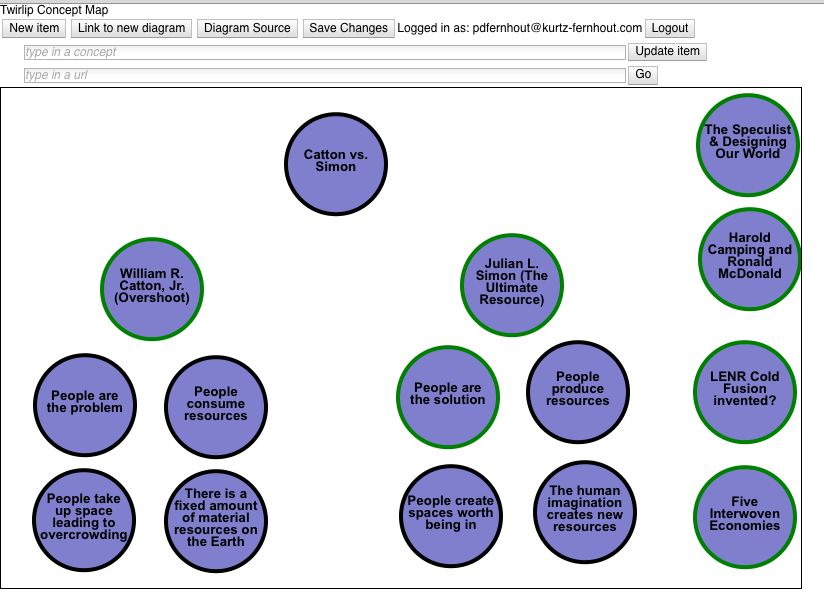
Twirlip Concept Map Screenshot with an example contrasting the writings of William Catton and Julian Simon
Some further analysis on socioeconomic trends and their implications
Here is my own take on what is going on right now in our society. Obviously, it is limited by just being one person's perspective. An it no doubt has its flaws. Hopefully people working together with better tools, or even just the great tools we already have with the internet, will produce even better summaries. Of course, part of the issue is that summaries about socioeconomic issues and politics are themselves political. As Deborah Stone write in "Policy Paradox: The Art of Political Decision Making, Revised Edition", "you can’t take politics out of analysis" because real-world policy grows out of differing ideals, even definitions, of basic societal goals like security, equality, and liberty. Still, we can hopefully do better than we have today. There are good ideas in all political parties. There are also bad ideas in all political parties. It can be hard to sift through that all to come up with some healthy mix that makes sense for our society right now and in the near future.
The following is informed by insights from people like Marshall Brain, James Albus, Martin Ford, Jane Jacobs, Charles Fourier, Richard Wolff, Richard Stallman, Albert Einstein, Morton Deutsch, Alfie Kohn, John Holt, Joan Roeloffs, John Taylor Gatto, Steven Slaby, Ursula K. Le Guin, James P. Hogan, Elizabeth Warren, Amelia Tyagi, Ivan Illich, Michael Mahoney, Freeman Dyson, Ted Taylor, Douglas Lisle, David Goodstein, Michel Bauwens, Eric Hunting, Kevin Carson, P.M. Lawrence, Iain Banks, Harvey Cox, G. William Domhoff, E.F. Schumacher, Jacque Fresco, Stewart Brand, Buckminster Fuller, Dee Hock, Michael Phillips, Amory Lovins, Hunter Lovins, John Todd, Nancy Jack Todd, Manuel De Landa, Kenneth Rogoff, Carmen Reinhart, Gerard K. O'Neill, Frances Moore Lappe, David Brin, K. Eric Drexler, Hans Moravec, Victor Serebriakoff, Noam Chomsky, Herbert Simon, Robert Steele, Julian Simon, Larry Slobodkin, Patrick Grim, Philip Zimbardo, Slavoj Zizek, Dan Pink, Alan Kay, George A. Miller, Lev R. Ginzburg, Norman Spinrad, Gene Roddenberry, Alvin Toffler, James R. Beniger, James T. Liu, Alain Kornhauser, Jennifer Morgan, Juliet B. Schor, Marshall Sahlins, Suniya S. Luthar, as well as all the authors of the 1964 Triple Revolution Memorandum, and many, many others. If I can see so far, it is from "standing on the shoulders of giants", none of whom should be blamed for any errors in the following that are solely my own.
Mainstream economists have created a beautiful body of mathematical thought based on several key assumptions that has resulted in elegant equations worth admiring for their own sake. There is just one big problem with mainstream economics. Many of the assumptions are questionable. So, the mainstream equations in reality can produce divide-by-zero errors, such as when the value of human labor goes towards zero, or the cost of energy or information goes towards zero, or as supply of goods and services exceeds demand on a long-term basis and profit goes towards zero and the system freezes up.
Mainstream economists try to ignore these long term trends and divide-by-zero problems by assuming infinite demand. But infinite demand is just not in accord with healthy human psychology or the social dynamics in a healthy self-reflective society that cares about its future. See Maslow’s Hierarchy of Needs. Or think about the emerging “Reduce, Reuse, Recycle” ethic. Or see any of the world’s major religions — including humanism — about moving beyond materialistic values. So, mainstream economists' assumptions about demand always outpacing productivity increases are questionable. There remains some truth in them within limits, but not enough to prop up their entire mathematical house of cards in a hurricane of widespread social and technological change including robotics, 3D printing, nanotechnology, better design, AI, cheap communications, dirt-cheap solar panels (predicted), cold fusion (maybe), and voluntary social networks.
Mainstream economists also assume that robotics and AI can never replace most human labor in structured settings like warehouses, offices, and greenhouses. Ironically, as Martin Ford has mentioned, military planners are at the same time working towards robots that can function in unstructured battlefields. Which is it? Are robots going to be better than humans in unstructured battle settings or are robots always going to be less capable than humans in structured workplace settings? Even if the truth is in the middle, perhaps that robots will soon be fairly capable in a wide variety of semi-structured settings, that middle-ground is enough to break the income-through-jobs assumption so much of US society rests on.
Whatever the demand for stuff is, if robotics and AI and 3D printing can produce things cheaper, better, and more reliably than humans, then there will not be much of a market for most human labor (even as some rarer skills may still be in great demand). If voluntary social networks emerging through the internet can produce intellectual "milk" for free, why pay a person to produce, say, newspaper articles in-house? There may remain some reasons, but more and more, such reasons become about things like guarding and creating "artificial scarcity". Those approaches to organizing a society will ultimately begin to feel more and more dysfunctional in an age of abundance (even as there may always be some reasons to guard or filter, and there is truth that an abundance of one thing can sometimes create a complementary scarcity of something else). There may still be ways production is coordinated in the future, like through emails, blog posts, and twitters, or via equivalents within networks of AIs and robots, maybe even entailing moving Kanban tokens as "funny money", but the flow of fiat dollars (ration units) that so defines much of our society will likely become much less important in such a future.
As humorist Douglas Adams wrote:
"This planet has — or rather had — a problem, which was this: most of the people living on it were unhappy for pretty much all of the time. Many solutions were suggested for this problem, but most of these were largely concerned with the movement of small green pieces of paper, which was odd because on the whole it wasn't the small green pieces of paper that were unhappy."
But our society currently depends on an income-through-jobs link for distributing the right to consume (for the vast majority of the population not living off the interest from capital ownership). Further, even if there is a demand for human labor, the growing rich/poor divide with the centralization of wealth also ensures that human laborers are at a huge disadvantage in negotiating wages, including by competing with each other with the law of supply and demand. Real wages for most workers have been flat for decades in the USA, and actually declined in the 2000s. Potentially, in an advanced economy, laborers can be forced to accept less than even subsistence wages. The difference is made up by workers being forced to consume or erode various non-currency capital the have such as health, family relationships, wardrobe, skills, education, automobiles, and so on, as well as currency-related capital like home equity (when they have it) or to run up credit cards. The 2008 financial crisis in the USA can be seen as an inflection point as US workers in general reached the point of eroding their home equity close to zero as they struggled to keep going at the level of consumption they had come to expect in US society. But ratcheting down their consumption levels just made the financial crisis worse.
Our world has the physical capacity for everyone to have a very nice life materially. But our mainstream economic dogma emphasizes competition and an income-through-jobs link. That pretty much ensures most people will suffer needlessly as our labor-based economy continues to implode in many areas. This creates a vast amount of social stress in a society.
That effect is strongest in the USA right now. But in the absence of broader socioeconomic changes, it will spread to other countries as they too go through the curve of increased technological capacity. Even China is starting to automate heavily due to issues about rising wages and issues about increasing expectations about quality. Countries that have better social safety nets (like universal health care and broader social welfare and more public investment in infrastructure and social programs) will have more resiliency in the face of economic problems, but even those conventional programs as-is, that still assume such social assistance is "temporary", may not be enough to deal with the huge changes ahead.
Eventually, the balance will change in one of several ways. Here are three possibilities. People might engage in a political struggle leading to broad changes and broader equity in global resources (which is what is going on in some parts of Europe right now, as in the past). Or, some compromise might be achieved where lots of make-work is created (through needless wars-of-choice, endless bureaucracy, endless schooling, expanding prisons, or widespread avoidable sickness) that props up the income-through-jobs link (which seems to be the path the USA is going in part). Or poor people might essentially be starved to death or worked to death, and the remaining wealthy people will, among themselves and their robots, essentially produce a new society of the remaining people that is based on a new paradigm of broadly shared wealth (there are aspects of this that have been going on for a long time in the globe). That last option would be ironic because the robots, in combination with the material resources of the solar system, could just as easily produce wealth for quadrillions of people as for millions of people, and a bigger society is probably going to be more interesting. In practice, we seem to be seeing a mix of all three of these approaches. Which one will dominate long-term remains to be seen. Also, there may be other possibilities, of course.
Given the potential of technology as an amplifier, including through WMDs like nuclear bombs, robotic drones, and biotech plagues, it is possible that everyone will lose if the overall social stress level gets too high. I have devoted most of my personal resources to trying to prevent that, as have many others. As Bucky Fuller has said, whether it will be Utopia or Oblivion will be a touch-and-go relay race to the very end. For good or bad, it is a very "interesting" time to be alive. Our individual decisions may very well tip the outcome one way or another.
About me and this rambly site
For anyone trying to understand me or my life, this movie poster says all too much about me, for good or bad:
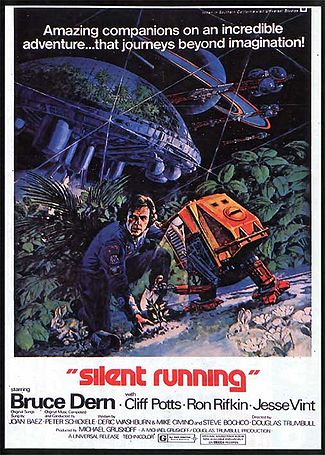
The Silent Running movie poster from 1972.
I saw Silent Running on TV a couple years later and it made a big impression on me at around age ten.
The robots there were amazing and inspired R2D2 in Star Wars as well as my own creations.
In the movie, almost all of Earth's plant life that was not paved over gets blown up by nuclear explosions.
This happens because almost no one cares about forests and gardens and diversity anymore
and the forest are deemed just too expensive to mantain "in domed enclosures blasted somewhere out in space".
That movie (also a reflection of the culture at the time) set the tone for much of my early career with work and study in robotics and ecology.
In a way, it influenced even my marriage to someone who loves nature and our eventually living with with our child on about fifteen acres of forested land in the heavily forested six-million-acre "Forever Wild" New York Adirondack Park.
That might be a nice ending, except the nukes (and similar) are still out there
ready to launch for ironic political or technical reasons.
And so I continue to work towards software for sensemaking and community (instead of software for robot caretakers,
as fun as that would be to write) out of continuing hope that we can somehow still avoid an even worse fate than the one predicted in the movie
where at least "... there's hardly any more disease. There's no more poverty. Nobody's out of a job." Still,
that challenge will no doubt be an unending struggle for endless future generations
to preserve diversity
while still making things great for most people who may not always get along that well and value different things.
One could hope our robots, information management software, and other systems we create could help us with that more than hurt.
Still, as a worrier, I can now worry about Eliezer Yudkowsky's quip
on "Moore's Law of Mad Science: Every eighteen months, the minimum IQ necessary to destroy the world drops by one point." While
I may not agree 100% with that quip, it certainly captures a sentiment about a continuing trend
related to technology and society.
To me, that is another good reason to expand human civilization into space like through self-replicating space habitats,
while at the same time trying to increase our collective social intelligence and sense of social justice to try to avoid the destruction of human and other life on Earth.
And fortunately there is a lot of synergy between those two goals, since technologies needed to live well in space
such as recycling and advanced manufacturing and robotic agriculture could help a lot in creating abundance for all on Earth.
If you can dream it: (even if they are dreams you picked from seeing ideas elsewhere,
picking some good stuff from among some dystopian bad stuff in the Silent Running movie)
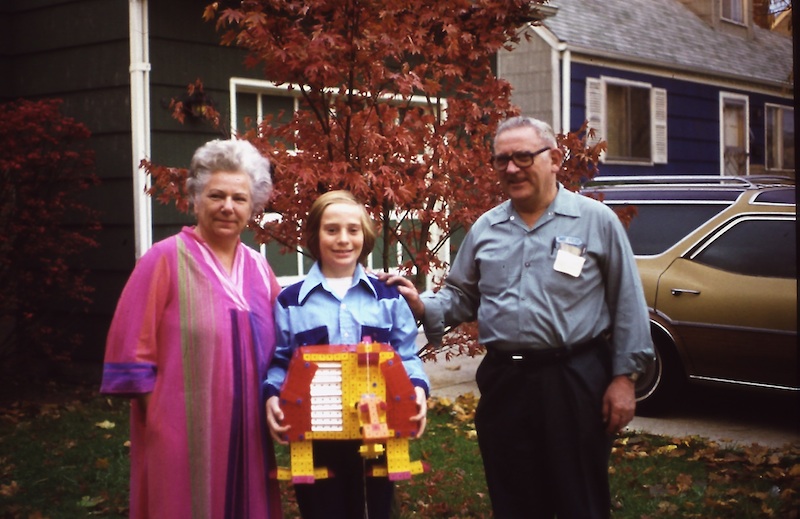
Me around 1976 with my parents and a model of a Silent Running Drone robot made out of Togl's. The arm and gripper could be actuated by strings and a bellows.
You can probably build it: (well, at least somewhat, and if you have some support and encouragement and luck... :-)
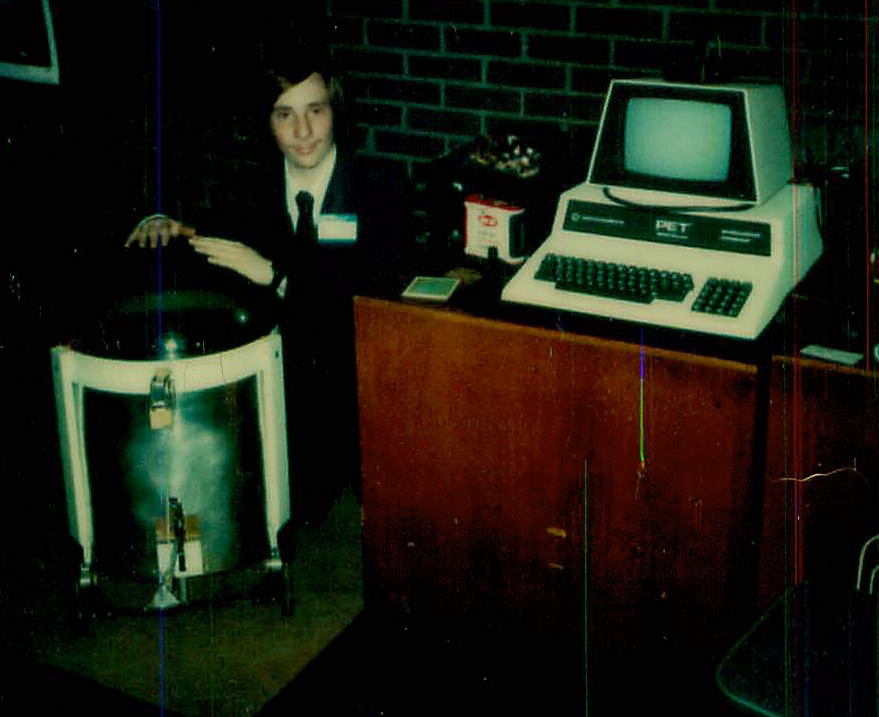
Me with one of my line of ROSCOE (Remotely Operated Self-Contained Operational Entity) robots at the Robotics Futures Expo in 1980, where Isaac Asimov called me a "Rotten Kid". :-) ... Luck, resources, and encoragement includes having a helpful father who knows how to use machine tools to get a gripper and some brackets made -- though I did the electronics, programming, and much of the scrounging myself. That's a rolling bar with an upside down salad bowl on top. The gripper design is taken from a triple-fingered sugar cube tong (my father machined it at work on his lunch hour). The robot could repeat patterns of motions input through a joystick, and could also be directed to do motions via typed commands in English and German. Out of the blue, an earlier version (predating R2D2, but similar looking) had won a Navy Science Award at a local science fair (maybe in part as I described it as a "nuclear material transporter" inspired by something I saw at Brookhaven National Labs' nuclear reactor, and the Navy encourages nuclear sorts of things -- so began my first unintentional ambivalent entanglement with "National Security". The relays sometimes would stick and overheat and start to smoke and I'd have to bang the interface box to unstick them, but at least the opto-isolators (carefully sorted through from from Radio Shack packages to get the rare higher current ones) kept the computer safe from other mistakes. The Radio Shack stores in the area seemed to recognize me and my father as a pair, going in to buy various parts. Not that there is anything really very expensive in the robot system, other than the PET computer. Still, it would not have been possible without my father's help and involvement. Thanks, Dad, for helping me realize some of my dreams. I hope you are on to better things. And I can also thank various school teachers for help along the way, too, especially Jack Woelfel (who also had a computer company and loaned me PETs), Joe Maurer (who let me in early to use the school computers), David Gray (who stayed after to run the computer club), and Dr. Farabaugh (who taught the junior high science class I built a first robot for).
What is next to dream, design, and to build?
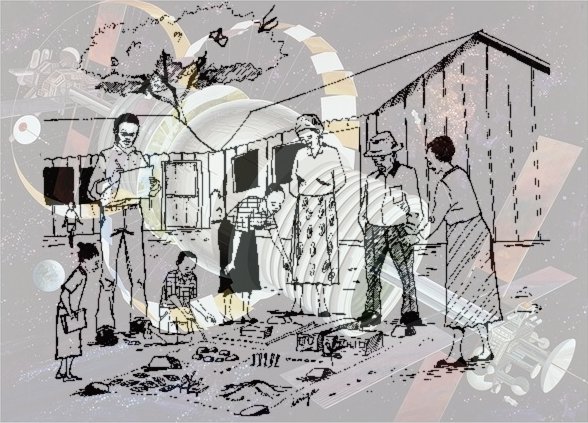
Artwork derived from NASA artwork by Rick Guidice on Space Colonization
blended with a modified version of the Land-use plan artwork by Richard Iriga
from the Development Art collection using The GIMP under Debian GNU/Linux (Yes, I know about the dangers of the "Second System Effect". And from first hand experience, all too often. :-)
Unfortunately (or fortunately?), my robotics career sort of derailed in the late 1980s alongside the AI winter, when I foolishly left a good job managing the Princeton Robotics lab, and then had repeated problems at graduate schools trying to get a PhD related to space habitats. I also got more involved with computer graphics and desktop software (which are just cheaper and easier to work on, and I never was much of a machinist). And I also got more involved with organic agriculture, gardening, and ecology.
I've mainly been writing, thinking, reading, and programming ever since, especially in relation to understanding nature, technology, and society. Sometimes I really miss the hands-on robotics work. The Open Skutter Project is a recent idea of mine, but I don't have much time/resources to pursue it, except maybe a little for fun with my kid someday.
The economic, social, and security issues raised by robotics and other automation have still long been on my mind (along with issues related to better designs and, now, voluntary social networks). I have written a lot about those things like with the links in the next section. So, robotics has continued to play a big part in my life, indirectly. And certainly the confidence of some early success in dreaming and doing has been useful, even when later (harder) things haven't worked out or have taken a long time to realize.
Lots of links to my writings
These are some writings I have made over the years.
Many are in the form of (long) emails I have written to one mailing list or another. In deference to the common complaint that email should only be used for short posts, I started putting long things here in public and linking to them. Still, I have always seen email as a distributed knowledge system, where, long or short, you read things or not as you wish. Sort of like the ideas for a "Social Semantic Desktop". But, sigh, I have to admit that email is in practice not there yet. And some people still use "digests" and old email tools. :-(
Most of these essays and emails are reflections of the same commom core themes
in the areas of free software and the emergence of a post-scarcity society.
That post-scarcity society is developing based on ideas like:
* "imagine",
* "the internet",
* "3D printing"
* "automation",
* "voluntary simplicity",
* "non-violence and conflict resolution through infinite games and transcending problems using imagination",
* "realizing compulsory schooling to turn children into soldiers is evil",
* "realizing just-in-case learning is mostly obsolete as cheap networked computers are changing things globally ",
* "constructivist education and learning-on-demand in a community are the educational way forward",
* "unschooling at home and freeschooling somewhere else",
* "the future of the public school is to become more and more like the public library",
* "money is a sign of poverty",
* "financial obesity isn't pretty",
* "a few can maintain for the many out of altruism (and perhaps showing off :-)",
* "self-replicating space habitats can support quadrillions of people around the Solar System, so there is room for everyone -- even the unborn",
* "the history of the USA isn't pretty, but it is well worth studying in detail",
* "mutual security makes more sense that unilateral dominance",
* "we need a balance of meshwork & hierarchy and of altruism & selfishness to build a healthy diverse universal society",
* "the Debian project as the flagship of the F/OSS movement is an example of the way forward", and
* "rethinking work to be play".
So, these ideas are mostly what you will find here. Over and over and over again. :-)
Essentially, here is the beginnings of an index into all the details and links to other people's writings to show why I believe these things. Each email or essay was written as I developed my understanding of these ideas over the past decade or two. And each was generally written to address some issue someone else raised on a mailing list, and I replied to each in isolation. So, here are many of those replies in one place.
But, rather than wade through all that, here are three of my most recent long essays which pretty much sum up the main ideas and links:
* The true cost of a Princeton-style education in the OLPC era (about 10 pages)
* Post-Scarcity Princeton, or, Reading between the lines of PAW for prospective Princeton students, or, the Health Risks of Heart Disease (about 200 pages)
* Post-Scarcity Princeton (about 40 pages, a condensed version of the essay above)
The first essay was written earlier, and
is more abstract and theoretical. The second essay was written afterwards, and is more specific to Princeton University and also
is a bit of a memoir about personal growth.
The third is a condensed version of the second with most of the personal and Princeton-specific comments removed.
Here are some more general comments about post-scarcity and academia.
Here was my statement of purpose for graduate school at Princeton, related to developing self-replicating space habitats:
* Self-Replicating Space Habitat graduate school purpose and plans from 1988
And here is information about a couple ventures I tried to bring together after PU graduate school under the name of Sunrise
(both as a non-profit and a for-profit); both fizzled, but there is also information there how those ideas scaled down to what I have done recently.
* Sunrise Sustainable Technology Ventures
Here is a little letter I wrote as if I was Gaia: :-)
*A letter from Gaia to humanity on the joy of expectation
And a practical implication of that letter:
*On Climate Change vs. the Singularity
*A p2p-research thread I started on Earth's carrying capacity and William Catton's mistaken assumptions
Here are a shorter and longer version of comments to grantmakers and donors on copyright and patent
policies for a Post-Scarcity Society (originally written in response to a request for comments by the Markle Foundation):
* An Open Letter to All Grantmakers and Donors On Copyright And Patent Policy In a Post-Scarcity Society
* On Funding Digital Public Works
Here is something I put together about moving beyond a jobless recovery (saved from deletionists on Wikipedia as a Google Knol as it represented a person-month or more of work to organize all these heterodox economic ideas and references, plus some interesting contributions by others; I especially liked the way the chart of four future heterodox possibilities came out with a basic income, a gift economy, local subsistence, and resource-based planning):
* Beyond a Jobless Recovery: A heterodox perspective on 21st century economics
Health care advice I posted to Slashdot about things like vitamin D and Dr. Joel Fuhrman's "Eat to Live":
* Vitamin D, whole foods, fasting, walkability...
And an even more comprehensive list of links about health and health sensemaking:
* Links on health tips and health sensemaking
Here are two creative-writing pro-peace postings I made to the (now defunct) Pacifica Radio forums in 2003:
* The Lion and the Butterfly
* The Lion Memo (with apologies to C.S. Lewis' The Screwtape Letters)
Here is a satire about what our society would look like if the law was like what lawyers recommend for everyone else:
* Microslaw
Here is a fable I wrote about thirty years ago about a knight who becomes whatever he wrote in a book (sort of like many self-defined Transhumanists aspire to :-):
* The Problems of Being Self Determining
Here is a five minute parable I made and put on YouTube:
* The Richest Man in the World: A parable about structural unemployment and a basic income
Here is why even millionaires should support a "basic income" and related taxes to help build a better society for everyone:
* Basic Income from a Millionaire's Perspective?
Here is something I sent to Bridgewater Associates (the world's biggest hedge fund) in July 2011:
* Comments on Ray Dalio's "Principles" essay
Some couple of poems I wrote, but I'll put them inline too as they are short:
* The Circle of Knowledge
The Circle of Knowledge
All philosophy is anthropology;
All anthropology is psychology;
All psychology is biology;
All biology is chemistry;
All chemistry is physics;
All physics is math;
All math is philosophy. :-)
* On Information, Knowledge, Intelligence, Wisdom, Virtue, and Effectiveness
On Information, Knowledge, Intelligence, Wisdom, Virtue, and Effectiveness
Information is not knowledge,
Knowledge is not intelligence,
Intelligence is not wisdom,
Wisdom is not virtue, and
Virtue is not effectiveness.
So, to have is not to organize,
To organize is not to embody,
To embody is not to value,
To value is not to act, and
To act (especially in ignorance)
is not necessarily to succeed.
Here are some ideas on a tensegrity robot I thought of, disclose here to prevent patenting the core idea (although I see now that others have had similar ideas before, so this is just left here for fun):
* Tensegrity Robot
Here is a way to improve education in New York State, rebuild the state's economy, and help NY families by creating
a basic income for families from the money currently given to NY schools (and why this is good even for teachers and school administrators):
* Towards a Post-Scarcity New York State of Mind (through homeschooling)
Lots of links on unschooling and online-related educational activities:
* Advice on early education (many links)
Posts I made to the p2presearch list concerning education (it would take years to read through all the embedded links on Gatto, Holt, Goodstein, Schmidt, Honigman, Lewellyn, etc.):
* [p2p-research] College Daze links (was Re: : FlossedBk, "Free/Libre and Open Source Solutions for Education")
* [p2p-research] The Higher Educational Bubble Continues to Grow
* [p2p-research] Rebutting Communique from an Absent Future (was Re: Information on student protests)
Here is something on related to James Randi that relates to skepticism, LENR Rossi/Focardi cold fusion, homeopathy, the paranormal, economics, and some other things:
* An Open Letter to James Randi on Skepticism about Mainstream Science
I haven't put the rest up yet, but I may, someday, in my idleness. :-) Until then, you can find them by reading
emails or other things I have posted publicly:
http://www.google.com/#q=site:http%3A%2F%2Fp2pfoundation.net%2Fbackups%2Fp2p_research-archives+fernhout
http://www.google.com/search?hl=en&q=%22paul+fernhout%22+slashdot
http://www.google.com/search?q=%22paul+fernhout%22
http://groups.google.com/groups/search?q=kfsoft+fernhout
http://groups.google.com/groups/search?hl=en&q=pdfernhout%40kurtz-fernhout.com
The first essays are about education in part because that is what I have been doing for years, educating both myself and others about these "powerful ideas". Plus most people in the world might enjoy seeing the flagship of global capitalism run into an iceberg. :-) As long as there are stylish lifeboats for all.
I have worked on-and-off towards a project now called Open Source
Communities Organizing Manufacturing Knowledge (OSCOMAK) as well as related
ideas:
http://www.oscomak.net/
http://www.kurtz-fernhout.com/oscomak/
http://www.kurtz-fernhout.com/oscomak/SSI_Fernhout2001_web.html
http://www.kurtz-fernhout.com/oscomak/KFReviewPaperForSSIConference2001.pdf
http://www.kurtz-fernhout.com/oscomak/AchievingAStarTrekSociety.html
I would like to implement that on a Pointrel Social Semantic Desktop I am slowly working towards:
http://sourceforge.net/projects/pointrel/
The Pointrel System is an RDF-like triple store implemented on the Java/JVM platform, supporting related social semantic desktop applications to create, use, exchange, and organize informational resources for a reasonably joyful and secure world.
I am concerned about how our society can transition from a scarcity-oriented one to a post-scarcity one in a non-violent way that brings abundance for all globally. One major thing I am concerned about is post-scarcity technology (like nuclear, biotech, nanotech, robotics, AI, communications, bureaucracy) wielded by people still focused on scarcity issues.
I have been programming for three decades, which generally has been how I have earned my living. In the 1980s, I became more interested in ecological issues, in part through interacting with people in a local Unitarian Universalist Social Concerns Committee in Princeton, NJ. I was program administrator for the Natural Organic Farmers Association of New Jersey for one season, and did other organic agriculture related things (volunteered at an organic farm, worked as a cashier at an organic foods store). That non-profit work led to writing a (free) garden simulator to help people better learn to grow their own food. http://www.gardenwithinsight.com/ That was a labor of love by my wife and I, and beyond prompting me to go to graduate school in Ecology and Evolution (where my wife and I met), it took over six person years to complete. It could still be vastly improved. Working on our own, we only scratched the surface of what is possible.
Here is something I posted to the Project Virgle mailing list that in part touches on the issue of Google's identity as a scarcity vs. post-scarcity organization:
* A Rant on Financial Obesity And Project Virgle and an Ironic Disclosure :-)
The ironic disclosure in the essay above on "financial obesity" is that in the process of trying to dig ourselves out of the vast amount of money we borrowed for living expenses to finish our free garden simulator project (we did it, but it took years of working for IBM Research and others afterwards), I helped my wife develop decision support tools to help decision makers see issues from multiple perspectives. This included supporting business decision makers, non-profit decision makers, as well as national security analysts for multiple governments.
Yes, some of *those* people -- who are not all bad, even if they are often caught up in systems
that feel beyond their control (including advising uncurious people like the past president,
where you have ten minutes in a limousine to explain the entire history of the Middle East and why
invading Iraq is a *really* bad idea, let alone moving onto Syria and Iran etc. afterwards).
How do you get an idea into the thick skull of someone who believes in something like this:
http://en.wikipedia.org/wiki/Axis_of_evil
Still, yes, those organizations are often involved in bad things:
http://www.betterworldlinks.org/index.php?cat=3730
But helping prevent more of that was part of the whole point (at least on our side).
Frankly, most government staff are bureaucrats sincerely interested in doing a good job to make the world a better, happier, safer, more abundant place (as they see it, which can be from a narrow perspective, thus the point of our work, on multiple levels). We tried to find a path that supported both national security and mutual intrinsic global security, through a process of constructive engagement, helping decision makers see the world from a bigger point of view. Not easy at all. And the potential to be a real ethical quagmire. And sadly, that can leave us with few friends, as we could be seen as "tree hugging info hippies" by the rightist war-leaning bureaucrats, and seen as "compromising-traitors-to-the-cause" by the leftist anti-war advocates. And even I can wonder how much we were making a difference and how much we were being used. It's hard to transcend a political system that makes little sense anymore in an age of abundance, where both left and right are two sides of a coin, a coin that is of less and less value as money (and war that springs from the profit-motive) becomes slowly obsolete, yet all the time still living in a crumbling economic system while you have to make a living. Somebody should make a game about that. :-) Basically, our lives. :-)
A favorite related quote from Manuel DeLanda is from: "Meshworks, Hierarchies, and Interfaces"
"To make things worse, the solution to this is not simply to begin adding meshwork components to the mix. Indeed, one must resist the temptation to make hierarchies into villains and meshworks into heroes, not only because, as I said, they are constantly turning into one another, but because in real life we find only mixtures and hybrids, and the properties of these cannot be established through theory alone but demand concrete experimentation. Certain standardizations, say, of electric outlet designs or of data-structures traveling through the Internet, may actually turn out to promote heterogenization at another level, in terms of the appliances that may be designed around the standard outlet, or of the services that a common data-structure may make possible. On the other hand, the mere presence of increased heterogeneity is no guarantee that a better state for society has been achieved. After all, the territory occupied by former Yugoslavia is more heterogeneous now than it was ten years ago, but the lack of uniformity at one level simply hides an increase of homogeneity at the level of the warring ethnic communities. But even if we managed to promote not only heterogeneity, but diversity articulated into a meshwork, that still would not be a perfect solution. After all, meshworks grow by drift and they may drift to places where we do not want to go. The goal-directedness of hierarchies is the kind of property that we may desire to keep at least for certain institutions. Hence, demonizing centralization and glorifying decentralization as the solution to all our problems would be wrong. An open and experimental attitude towards the question of different hybrids and mixtures is what the complexity of reality itself seems to call for. To paraphrase Deleuze and Guattari, never believe that a meshwork will suffice to save us."
My wife had been developing a free and open source version of related software here:
http://www.rakontu.org/
It is called Rakontu ("tell a story" in Esperanto) to help communities (and
organizations, groups, families) share and work with raw stories of personal
experience for mutual understanding, conflict resolution and decision support.
But, like everything, especially everything new, it is not perfect, and she doesn't have infinite resources to rework it.
So, she wrote a blog post suggesting people at least Steal these ideas: :-)
I spent part of last year building an open-source web application for story sharing and sensemaking in small groups. It's called Rakontu. This was a dream that began in 1999 (when I first started working in organizational and community narrative) and has been growing ever since. I used up years of savings to do it, and I was able to build far less than I would like to build someday, but I had a grand time and I'm glad I did it. I wrapped up the project about a month ago and posted an excerpt from a lessons-learned document for the project.
The ironic disclosure also relates to my comments on slashdot (August 2010):
* The need for open source sensemaking tools (Score:5, Interesting)
Amplified here:
* The need for FOSS intelligence tools for sensemaking etc.
I'm slowly making some related efforts with the Pointrel System, to try to integrate her ideas and others (like about structured arguments). We had discussed her using the Pointrel System for Rakontu when she started (which was, as usual, a work-in-progress), but decided that Google App engine would be a more widespread and well-supported platform for Rakontu (including providing free hosting). I instead worked independently on an evolutionary music application for the Android called Musical Phrases. That turned out to be a bit of a mistake for a few strategic reasons, including lack of synergy and lots of frustrations with a work-in-progress Google App Engine (though App Engine seems to have improved lately). At the moment, for want of a better name, I'm calling the combined system "Twirlip" but it is more a dream than a reality right now. The entire internet is more like an early version of Twirlip. :-) And Twirlip is a pretty pessimistic name. :-) Twirlip was right, but Twirlip was not listened to.
While I like the evolutionary music ideas (similar in some way to PlantStudio), I can see my interests are more in creating (and using) text-heavy information management tools bordering on collective AI, and always have been. Although, somewhere along the way I've become sort of an expert in post-scarcity issues, and that has mostly eclipsed my programming -- even though it has been through my thirty years of experiences with computers and robotics (and other things), and watching those fields change, that has been what has given me confidence to write about post-scarcity things. Just not enough hours in the day to do everything I want to do.
Plus, I remain really conflicted about the notion of having a paid Android app (even if I have promised to put the source under the GPL three years after each version is released.) At the time, it did not seem like services and such related to the Pointrel System itself might have much of a revenue stream (as our non-basic-income fiat-dollar economy collapses. :-)
But, now I can see that there may be something there, in terms of gaining support for such open sensemaking tools. As I wrote in that slashdot thread:
As with that notion of "mutual security", the US intelligence community needs to look beyond seeing an intelligence tool as just something proprietary that gives a "friendly" analyst some advantage over an "unfriendly" analyst. Instead, the intelligence community could begin to see the potential for a free and open source intelligence tool as a way to promote "friendship" across the planet by dispelling some of the gloom of "want and ignorance" (see the scene in "A Christmas Carol" with Scrooge and a Christmas Spirit) that we still have all too much of around the planet. So, beyond supporting legitimate US intelligence needs (useful with their own closed sources of data), supporting a free and open source intelligence tool (and related open datasets) could become a strategic part of US (or other nation's) "diplomacy" and constructive outreach.
As Bucky Fuller talked about with Comprehensive Anticipatory Design Science: "Think of it. We are blessed with technology that would be indescribable to our forefathers. We have the wherewithal, the know-it-all to feed everybody, clothe everybody, and give every human on Earth a chance. We know now what we could never have known before -- that we now have the option for all humanity to make it successfully on this planet in this lifetime. Whether it is to be Utopia or Oblivion will be a touch-and-go relay race right up to the final moment."
NIST has twenty people working on related stuff now:
"Sustainable and Lifecycle Information-based Manufacturing Program"
And there are thousands of people doing independent stuff, many of them young and eager to build a better world through "open hardware" and "open manufacturing" and even "DIY Biotech".
http://groups.google.com/group/openmanufacturing
I suggested the US government help with that:
"Build 21000 flexible fabrication facilities across the USA"
It's probably unrelated to me, but I'm glad at least some lawmakers have been talking about related things (but not yet doing them):
"H.R.6003 -- National Fab Lab Network Act of 2010 (Introduced in House - IH) by Rep. Bill Foster [D-IL14]"
http://thomas.loc.gov/cgi-bin/query/z?c111:h6003:
"(3) to seek to establish at least one Fab Lab per every 700,000 individuals in the United States in the first ten years of its operation."
But it looks like, at least in the USA, individual efforts will surpass things government fosters, which, in the case of DIY biotech that could benefit from reliable local containment, is a bit problematical.
"Safety of DIY-bio (was Re: Fwd: Meredith made AP)"
http://groups.google.com/group/openmanufacturing/msg/7084c1079c496dc4
Our ossifying formal social processes in the USA, mired in partisan gridlock, do not seem able to keep up with the rapid pace of technological and social change.
And so individuals and societies end up doing things in risky ways that are not strictly necessary given all the great abundance in our society.
But we need to quickly change our paradigm to survive with all the new powers we've discovered through our cleverness. As I mentioned here:
http://groups.google.com/group/openmanufacturing/browse_thread/thread/355985207bd4d88f
If ten years ago teens could make computer viruses at home, and if in twenty years or so, bullied and alienated teenagers will be able to make plagues in their garages, then what are we going to do when, perhaps, in a hundred years teens can make black holes in their basements? We need a new vision of society, or the people will perish.
What I see happening today isn't even really the failure of global capitalism
(focused on creating and managing scarcity) so much as the transcendence to
a new society (focused on creating universal abundance). A society where *everybody*
(apparent slacker or not) gets as a right of birth at least the
frugal basics of fresh air, clean water, organic food, quality shelter, 3D
printing, health care, internet access, and education, and yet also still
has a song in their heart unlike, say, living in the old gray USSR (and
hopefully love in their family, too; see: :-)
"All I Really Need" by Raffi
http://www.last.fm/music/Raffi/_/All+I+Really+Need
That's quite a challenge, obviously, but it is happening; the only issue
IMHO is how we as a community decides to relate to that trend. As I see it,
we are in the end game of global-capitalism-as-we-know-it, if only due to 3D printing.
This all suggests that our biggest danger as as society is in putting the *tools* (some being useful as weapons) of a post-scarcity civilization into the hands of scarcity-preoccupied minds. (Especially ones following outdated military dogmas like unilateral security instead of mutual security.) As Albert Einstein said, with the advent of atomic weapons, everything has changed but our thinking. This site is put up towards that end, changing our thinking, through helping change our collective mythology, especially in the non-profit sector.
For more details on how recognizing this irony may help us transcend militarism, see my comments here:
* Recognizing irony is key to transcending militarism
Or, see a little ironic story I wrote about trying to talk the USA out of collective suicide from scarcity fears called:
* Burdened by Bags of Sand.
And I recognize that is an idea it is going to take the CIA, NSA, and the rest of all those three letter agencies a while
to get used to, to be hopeful, since our lives rest in the interplay of various factions in such agencies. :-)
* CNC Machinist job related to custom bicycles & CIA version & comments
And maybe things would go better for me personally if I could resist prodding at such organizations with stuff like this: :-)
* On dealing with social hurricanes (like the US CIA)
These changes in thinking may be big sometimes, and they may be small sometimes. For example, here is an essay and book review about the "The War Play Dilemma" showing how this issue of how we address conflicts is woven into our parenting and play.
More than anyone, I need to thank Cynthia Kurtz, my wife for more than twenty years, for helping make me a better person by putting books and ideas in my way (like Zinn or Loewen or many others), and also for her boundless patience and generosity in giving me time to write all this.
More about me: Around 1998, my wife and I released three pieces of educational software which are still available at our original web site. You can also read about the history of these pieces of software. I worked for IBM Research and also at IBM's Internet Media Division as a contractor for a while afterwards. For about a decade I was a part-time stay-at-home Dad (trading off with my wife), and spent my idle time writing email and essays like these, as well as developing free software. Now most of my time goes into full-time work for others while my wife does more free work and homeschools our kid. I have been working on the OSCOMAK, OpenVirgle, Pointrel, and PataPata projects. I've posted a lot to the Open Manufacturing list. I also have posted stuff on sustainability, space habitats, F/OSS issues, and programming to various news groups, as well as slashdot and elsewhere. You can contact me at pdfernhout at kurtz-fernhout.com . Including "Paul" in the body of the email will help bring it to my attention.
Oh, yeah, and I'm embarrassed to admit I have a degree from Princeton University in Psychology (until they hopefully revoke it after noticing some of the essays on this site. :-). I transferred there from SUNY Stony Brook. And I got a Masters in Biology as a consolation prize for going back to Stony Brook and taking a spin through their Ecology and Evolution PhD program (where I also met my wife). Plus I've spent time before that around other academic PhD programs (including CMU CS & Robotics, NCSU Industrial Engineering, and the Princeton University CE&OR program) which I did as a volunteer or ultimately for which I did not receive a degree as one of the disciplined (enough) minds. Guess I was lucky in the end. :-) Hardly anyone back then took me seriously when I talked about self-replicating space habitats and computerized technology libraries; go figure. :-)
For some of the many sources of inspiration in my life, see: http://www.oscomak.net/giving_thanks.html
--Paul D. Fernhout
Twitter: pdfernhout
YouTube: pdfernhout
GitHub: pdfernhout
Commercial: http://www.artificialscarcity.com/ :-)
Licensing notices
Copyright 2008-2015 Paul D. Fernhout
The two personal pictures above should be considered under a CC-BY-NC-ND license.
With that exception, as for the rest of the content on this site,
permission is also granted to copy, distribute and/or modify material from this site under the terms of
the Creative Commons Attribution-Share Alike 3.0 Unported license:
http://creativecommons.org/licenses/by-sa/3.0/
Also, feel free to quote short sections with linked attribution in emails or on web pages.
Note that I sometimes include material (quotes) I consider covered under "fair use" -- whether that material's inclusion can still be considered "fair use" in derived works in other contexts outside this site is a potential issue for such future authors to resolve for themselves.
Note: no license ever grants permission to modify text a person wrote, or to selectively quote it, in such a way as to intentionally misrepresent what a person said and then attribute the changed text back to them. There are other laws and ethical principles that cover that kind of stuff.
Since most of the stuff here represents my opinions, it might take some rewriting to make them yours :-) or to make them into something more abstract.
Last major update: April 2018